Constraint-Based AI Systems
Building governance layers that align generative output with intent and structure.
CREATIVE INSTRUMENT SYSTEM
AI | Baxley Commons
Designing a Layered Evaluation Framework for AI-Assisted Design
Reducing subjective feedback loops and preserving system integrity at scale.
Role & Scope

COMPANY
Baxley Commons
ROLE
Lead Designer
Product Designer
Founder
OVERVIEW
PROCESS
Rapid Prototyping
Stress Testing Environment
A constraint-driven system that turns generative speed into production continuity.
The objective was to design a framework that:
Preserves structural coherence
Reduces decision drift
Enables controlled experimentation
Scales across visual and product surfaces
Rather than limiting creativity, constraint defines the structural boundaries within which variation becomes meaningful.
The result is a layered AI design framework that separates stability from styling — allowing exploration without collapse.
THE CONTEXT
AI dramatically increased creative velocity — but at the cost of continuity.
Ideas fractured across prompts, tools, formats, and audiences.
Each iteration moved faster, but less connected to the last.
Instead of building forward, work repeatedly reset.
THE GOAL
Design a governed AI system capable of producing consistent, production-ready artifacts across formats — without constant manual correction. The focus was control, not novelty.
Clear structural logic (K-Plate)
Predictable outputs
Reusable components
Reviewable state memory
Scalable theming across brands
Speed Scales Output. It Also Scales Drift.
AI makes it easy to generate outputs quickly. What it does not preserve is memory:
Why a direction was chosen
What constraints shaped it
What was rejected
What must remain consistent
Each prompt produces a new artifact —
but not a connective record of decisions.
Over time, iteration accelerates
while intent fragments.
GUIDING PRINCIPLES
Speed without memory creates noise.
Speed with continuity creates leverage.
Design systems, visual memory, and AI can operate together — not to replace creative judgment, but to protect it.

THE INSIGHT
The challenge wasn’t AI capability.
It was what disappeared between generations.
AI did not need more power.
It needed constraint memory.

“As options multiply, intent becomes
harder to track.”

What This Revealed
I didn’t need more prompts. I needed:
Enforced structural layers
Locked constraint memory
Controlled variation boundaries
Reviewable decision surfaces
Failure defined the architecture. Constraints weren’t decorative. They were corrective.
“Each iteration was visually plausible. Across iterations, the system identity collapsed.”
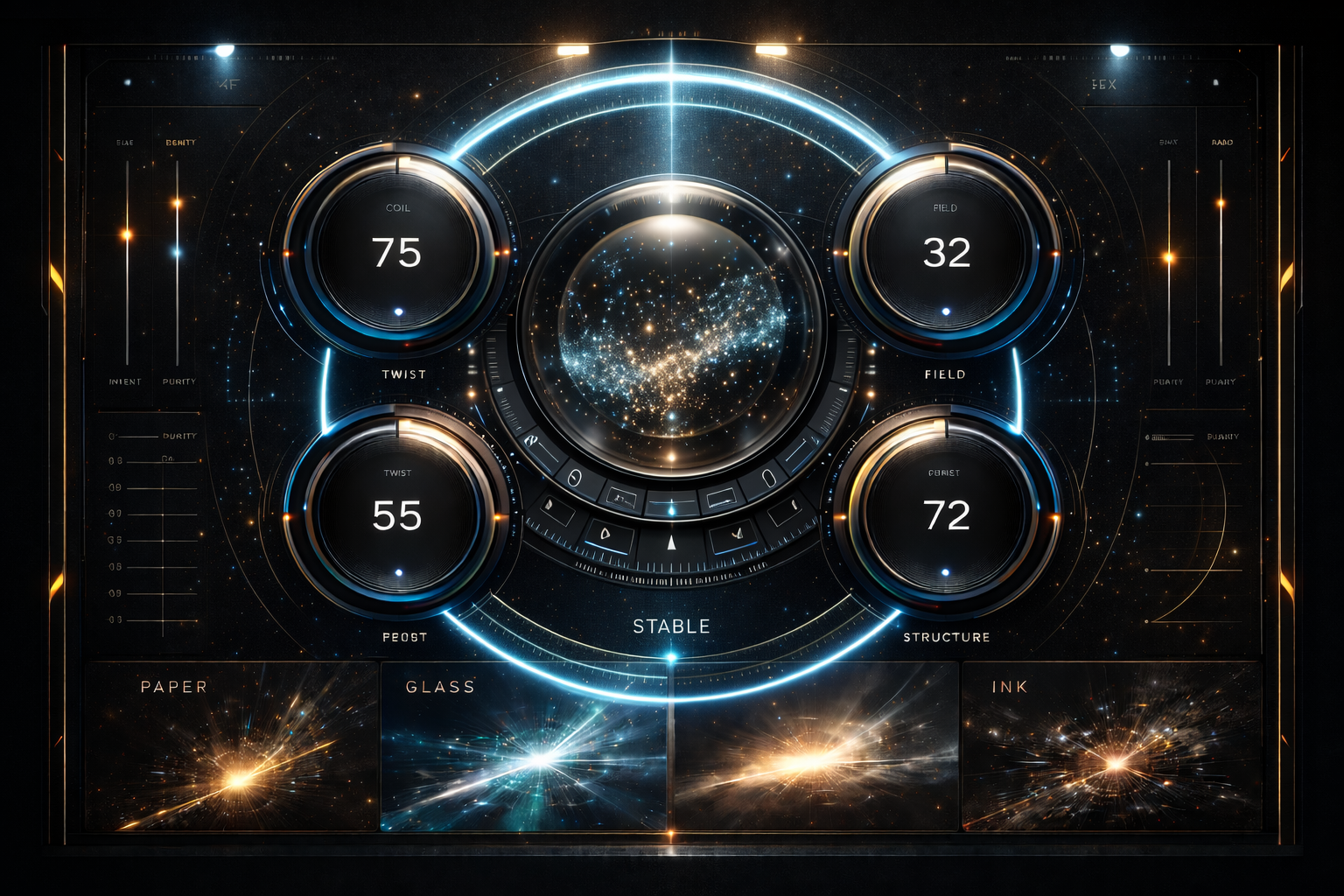
THE STRUCTURAL RISK
As options multiply, intent becomes harder to track.
The console illustrates the pattern:
More toggles
More states
More combinations
No enforced hierarchy
Without structure, velocity produces entropy.
Letting It Fail on Purpose
Why Intentionally Remove Guardrails?
Before designing constraints, I needed to understand failure.
So I removed them.
No enforced hierarchy.
No locked geometry rules.
No plate memory.
No production state tracking.
The goal wasn’t better output. It was controlled collapse.
What Broke, Failures Surfaced Immediately
Failures surfaced immediately:
Visual drift across iterations
Inconsistent hierarchy
Lighting logic flattening under variation
Loss of semantic meaning across patches
Inability to reproduce specific states
Each output looked plausible in isolation.
Across iterations, continuity collapsed.
The Real Insight
The issue wasn’t style inconsistency. It was state loss.
The system had no memory of:
Structural boundaries
Layer ordering
Intent anchors
Decision history
AI generated artifacts. It did not preserve architecture.
TOOL
ChatGPT
Gemini
Tik Tok
Instagram
iOS Photos
THE CORE PROBLEM
Unconstrained AI produces volume quickly — but introduces hidden costs:
Inconsistent visual language
Loss of authorship memory
Increased review and cleanup time
Difficulty reproducing or scaling results
The challenge wasn’t AI capability.
It was what disappeared between generations.
World Building and Character Prototyping
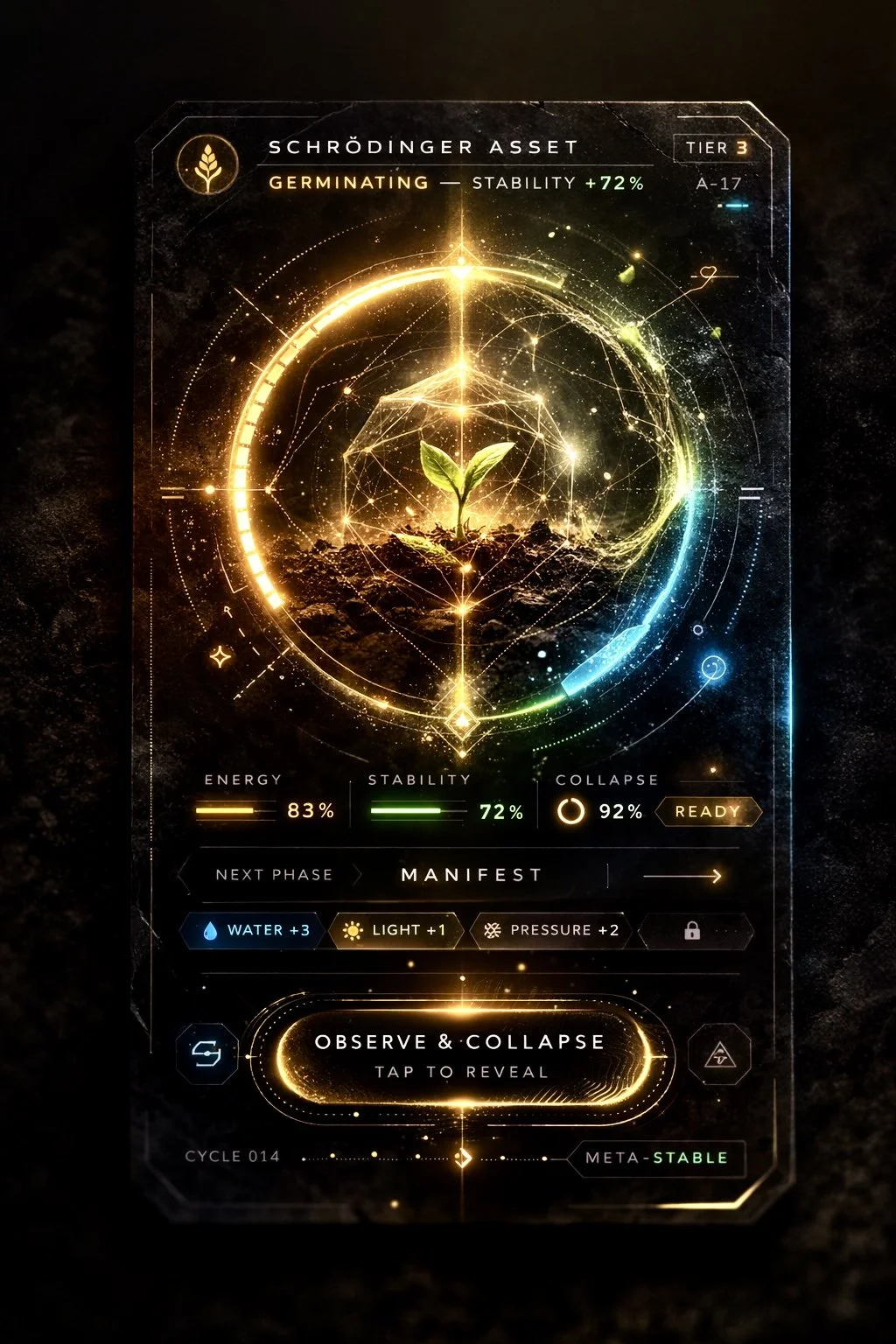
Cards, characters and creating a world system has been working on with my AI work. Instead of chasing outputs. I have been basing a lot of my work on a novel I was writing. So I have been focusing a lot on:
Testing the System - Creating stable defaults
Setting constraints and parameters and stress testing to system to see what it can do.
Every comes down to creating cards and codexing the design system. Since chatGPT doesn’t have a repository, my next move is to export code from chatGPT to create a clean foundation design / illustration system in Claude
Another focus was to create a new style and not rely on any defaults.
Most of my work right now lives in Dark Mode because I don’t think anyone has correctly implemented it in design systems yet.





Introducing the Constraint Layer
Why Speed Alone Wasn’t Enough
Once I could reliably generate outputs, the issue was no longer quality.
It was memory.
AI could produce variation.
It could not preserve structure across iterations.
So instead of adding more prompts, I introduced a structural substrate:
A constraint layer that governs every output.

“Constraints precede expression. Expression emerges only after the structural stack resolves.”
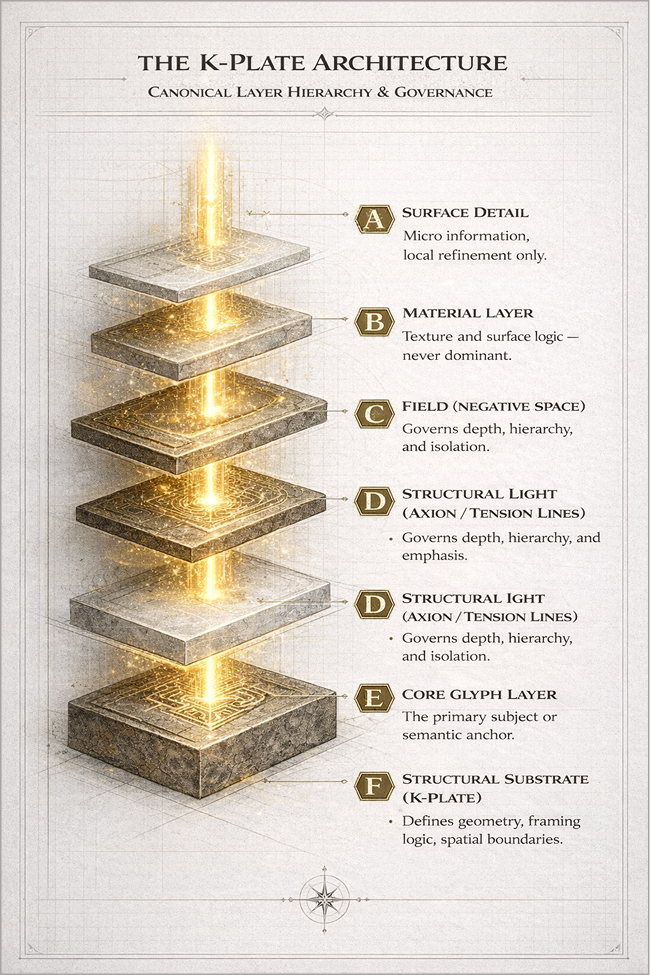
The K-Plate Architecture
The system enforces a layered hierarchy:
Structural Substrate (K-Plate)
Defines geometry, framing logic, and spatial boundaries
Core Glyph Layer
The primary subject or semantic anchor
Structural Light (Axion / Tension Lines)
Governs depth, hierarchy, and emphasis
Field (Negative Space)
Controls breathing room and isolation
Material Layer
Texture and surface logic — never dominant
Surface Detail
Micro information, local refinement only
Each output resolves through this stack — visible or not.
What This Enforces. Layer ordering cannot invert.
Lighting cannot override geometry
Color modulation cannot break hierarchy
Surface detail cannot dominate structure
Variation remains within defined boundaries
This shifts AI from a generator to a governed instrument.
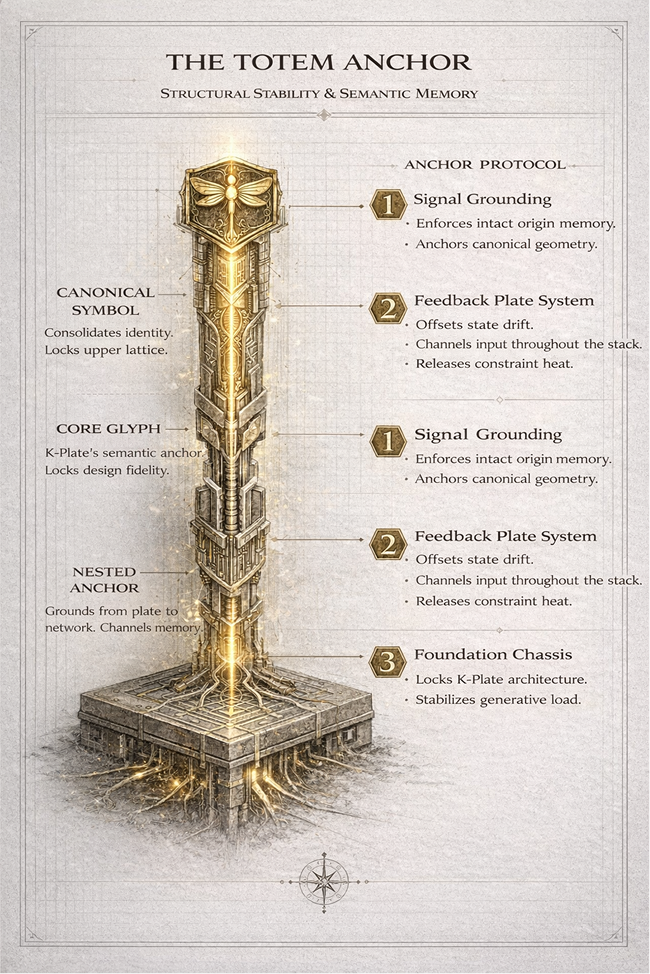
Totem Anchors — Identity Stabilization
Where K-Plate governs structure, Totems govern meaning. A Totem is a semantic anchor embedded within the stack.
It preserves identity across variation.
Without a totem:
Style can shift without warning
Lighting can overpower subject
Meaning can dissolve under iteration
With a totem:
The core symbol remains stable
Variation resolves around identity
Semantic drift is contained
Totems function as:
Identity locks
Memory anchors
Upper-bound constraints
Cross-surface continuity markers
They ensure that no matter how lighting, density, or material modulation shifts, the system’s core symbol remains intact.
Totems do not decorate. They stabilize.
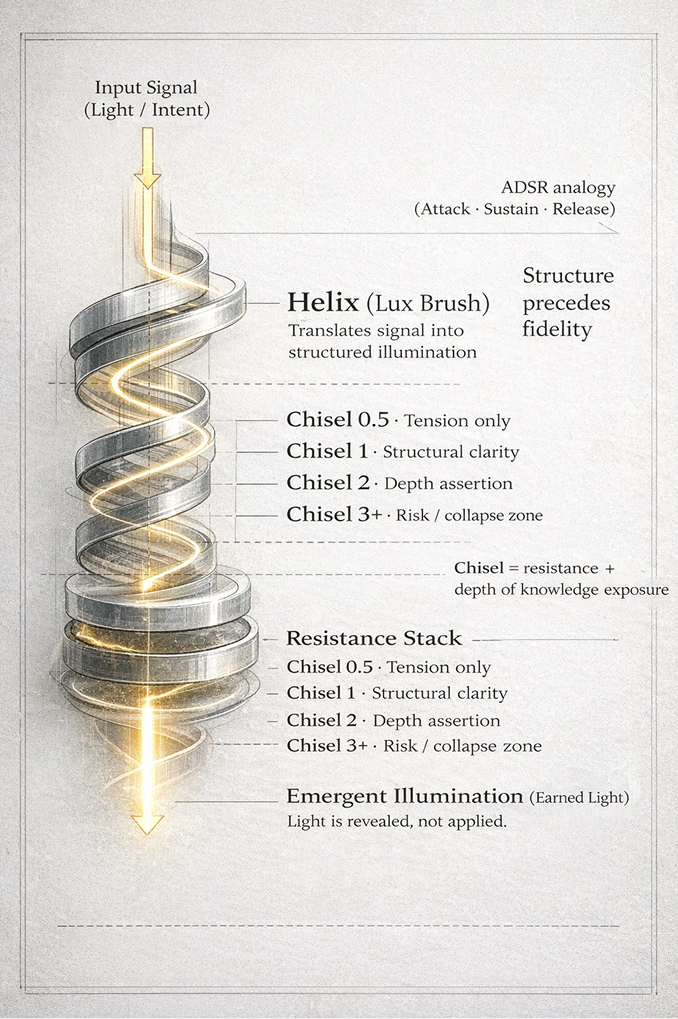
Chisels — Controlled Depth & Risk Management
If K-Plate defines structure and Totems preserve identity,
Chisels regulate variation depth. A Chisel is a calibrated resistance layer.
It determines how far an output can push before structure destabilizes.
Chisel Levels:
Chisel 0.5 — Tension only
Anchors depth emphasis without structural distortion
Chisel 1 — Structural clarity
Reinforces hierarchy and geometry boundaries
Chisel 2 — Depth assertion
Allows calibrated contrast expansion
Chisel 3+ — Risk / collapse zone
Experimental variation with structural stress
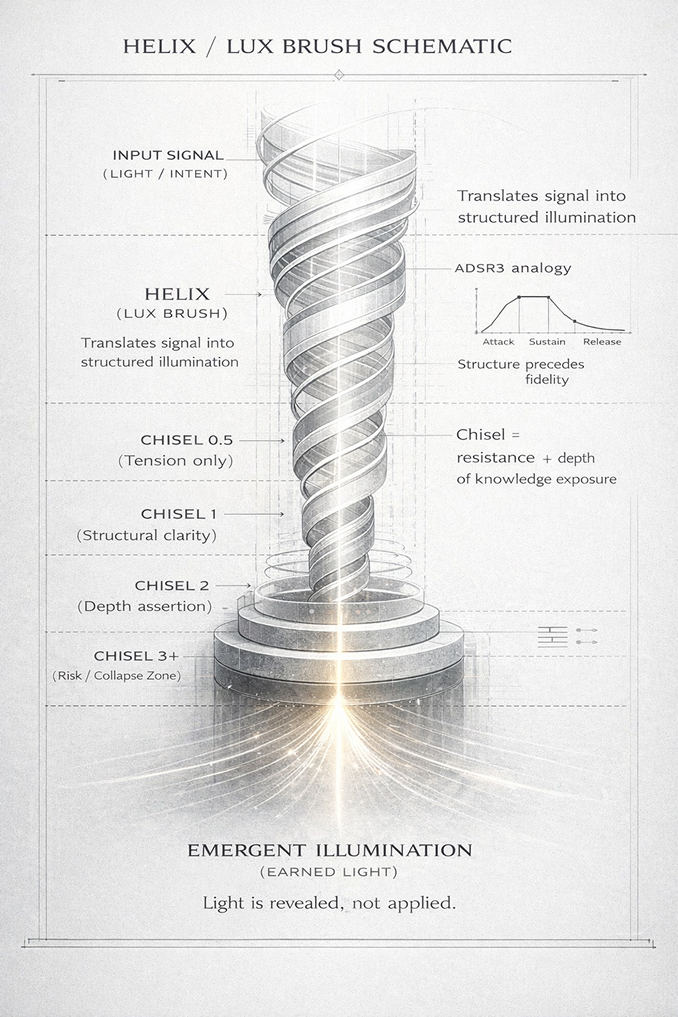
Chisel is not a stylistic control. It is a resistance dial.
It controls:
Contrast exposure
Illumination intensity
Structural load
Collapse thresholds
Light is earned through resistance.
It is not applied.